- Obniżka
- Nowy
Exploring Digital Safety and Competence Through Collective Autoethnography
Publikacja dostępna w wersji papierowej oraz elektronicznej e-book:
Najniższa cena w ciągu ostatnich 30 dni 35,00 zł
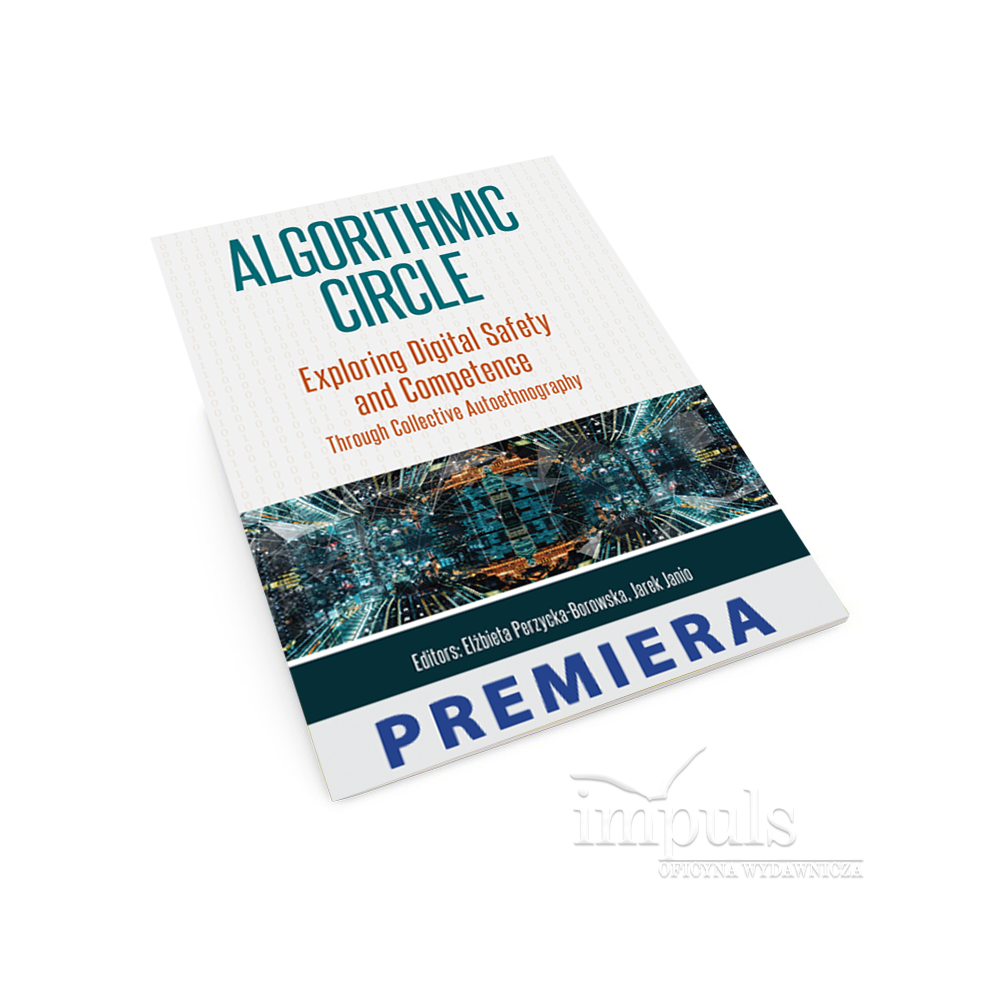
Exploring Digital Safety and Competence Through Collective Autoethnography
Publikacja dostępna w wersji papierowej oraz elektronicznej e-book:
The Algorithmic Circle is an interdisciplinary, multicultural study aimed at exploring the relationship between artificial intelligence (AI) and educational, social, and cultural processes. This project is grounded in the methodology of collective autoethnography (CAE) and weaves together the personal experiences of researchers with reflections on the changing role of academic teachers in the age of advancing technologization. We begin with the premise that AI, increasingly embedded in education and society, is not merely a neutral tool. It actively shapes codes of communication, reformulates the very notion of knowledge, influences cultural norms, and redefines what it means to sustain authentic, humanistic relationships between people. [...]
The metaphor of the algorithmic circle serves as our interpretive framework, symbolizing the ongoing process of mutual influence, the sharing of insights, and the expansion of research perspectives. Each individual reflection, rooted in personal context and worldview, becomes a point of departure for dialogue with other team members. The result is not a static sum of opinions but a dynamic, multifaceted creative process that generates new and deeper understandings of AI’s impact on education and society. In this dialogical practice, the algorithmic circle becomes not only a theoretical construct but also a research praxis, a space of mutual learning, confrontation, and transformation. [...]
Opis
Specyficzne kody
Researchers involved in the project
Marcella Abudho
Researcher and doctoral candidate in management and quality sciences at the Institute of Management, University of Szczecin, Poland. She is also an assistant lecturer in the Department of Business and Management at Pwani University, Kenya. Her scholarly interests focus on the intersection of organizational development and the evolving technological paradigms of Industry 4.0 and Industry 5.0. Her research areas include technology strategy, artificial intelligence, knowledge transfer, collaboration, and policy in market contexts.
e-mail: marcella.abudho@phd.usz.edu.pl
ORCID: https://orcid.org/0009-0000-3180-3998
Oliwia Bator
Researcher and doctoral candidate in linguistics at the University of Szczecin. Her work focuses on pragmalinguistics, phraseology, and Slavic studies, with particular interest in the comparative analysis of Polish and Russian language use. She combines theoretical reflection with empirical investigation to explore how social, cultural, and digital factors shape contemporary language practices.
e-mail: oliwia.bator@phd.usz.edu.pl
ORCID: https://orcid.org/0009-0006-7455-9685
Aleksander Cywiński
PhD, Assistant Professor at the University of Szczecin, Faculty of Social Sciences, Institute of Pedagogy, Department of General Pedagogy and Cultural Studies, and at the Polish University Abroad in London. Doctor of Social Sciences in pedagogy. He is also a lawyer and educator. Former probation officer for adults. His work addresses human rights and family law, as well as issues related to culture. His scientific interests are diverse and include the transformative role of education, law, and a deep appreciation for cultural diversity. He is currently participating in the CAPHE and GUARDIAN projects under Horizon Europe.
e-mail: aleksander.cywinski@usz.edu.pl
ORCID: https://orcid.org/0000-0002-3945-9607
Marta Gliniecka
PhD in Social Sciences at the Koszalin University of Technology, educator, and researcher focusing on the role of new media, particularly their educational potential. Her academic interests also include the creative expression of children and young people in various forms. For many years she has been actively involved, as a musician, in the educational projects of the STOP Theatre. She also creates original music, available on YouTube: https://www.youtube.com/user/Sofitimara.
e-mail: marta.gliniecka@tu.koszalin.pl
ORCID: https://orcid.org/0000-0002-5620-9757
Jarek Janio
PhD Faculty Coordinator at Santa Ana College School of Continuing Education. Founder of the Friday Student Learning Outcomes (SLO) Talks and the Annual SLO Symposium. His research and professional interests focus on the assessment of student learning outcomes, behaviorist approaches to education, adult learning, instructional design, and the impact of AI on teaching and assessment. He publishes regularly in Psychology Today, The EvoLLLution, and the COACHES blog.
e-mail: janio_jarek@sac.edu
ORCID: https://orcid.org/0000-0002-8672-5621
Krzysztof Jaworski
MA in Pedagogy, consultant teacher at the West Pomeranian Teacher Training Centre, specializing in developing digital competences among young people and teachers. Graduate of the Teacher Training College in Gliwice (intellectual disability education with computer science), the Pedagogical Academy in Kraków (BA), and the University of Szczecin (care and resocialization pedagogy), as well as numerous postgraduate programmes in computer science, coaching, and educational management. He completed the CEO School of Trainers and European Schoolnet programmes, Future Classroom Lab (2015) and EU Code Week Summer School (2023). Former support teacher and IT teacher, later an educator and coordinator of nationwide projects in cooperation with NGOs. Participant in international Scratch conferences (Budapest, MIT Boston, online) and speaker at many national educational events (including TEDx, Inspiracje). Author of over one hundred lesson plans and teaching materials in digital education. Three-time honoree on the list “100 people who significantly influenced the development of digital competences in Poland” (2018, 2020, 2023). Winner of the West Pomeranian Marshal’s Award for teaching activity in 2024. Currently a doctoral student at the University of Szczecin. His academic interests include teacher education, digital competences, actor-network theory, and didactics.
e-mail: krzysztof.jaworski@usz.edu.pl
ORCID: https://orcid.org/0009-0006-3602-5965
Anita Karyń
PhD in Social Sciences, Assistant Professor in the Department of General Pedagogy and Cultural Studies, Institute of Pedagogy, University of Szczecin. Sensory integration therapist, school and special pedagogue at ZSO No. 7 in Szczecin.
e-mail: anita.karyn@usz.edu.pl
ORCID: https://orcid.org/0009-0003-9436-1332
Edyta Kowalczyk-Łuc
MA political scientist and researcher at the University of Szczecin (Institute of Political Science and Security Studies). She graduated from the Institute of Political Science at the University of Szczecin and pursued additional interdisciplinary training in sociology at the University of Szczecin. She also studied at the Faculty of Law of the University of Salamanca as part of the Socrates Erasmus programme. Her research interests include European cooperation, political marketing, and security, with particular attention to the social and institutional conditions shaping these processes. Recently, she has focused on the impact of new technologies on upbringing and socialization, including algorithmic and generative sharenting as an emerging pedagogical and social challenge.
e-mail: edyta.kowalczyk-luc@usz.edu.pl
ORCID: https://orcid.org/0009-0005-0345-8329
Krzysztof Łuszczek
PhD in the Humanities, Assistant Professor in the Department of General Pedagogy and Cultural Studies, Institute of Pedagogy, University of Szczecin. Coordinator of the international seminar Media Education and Art. He works in media pedagogy and media theory. Author of the monographs Nowoczesna telewizja, czyli bliskie spotkania z kulturą masową (Tychy, 2004), Kontrola społeczna nad dziećmi i młodzieżą w środowisku mediów elektronicznych. Studium porównawcze na przykładzie Stanów Zjednoczonych, Wielkiej Brytanii i Polski (Szczecin, 2013), Wolność i kontrola w Internecie drugiej fali. Cyfrowe dylematy społeczeństwa obywatelskiego w Stanach Zjednoczonych i Unii Europejskiej (Tychy, 2015), and numerous articles on the impact of new technologies on education. Director and editor-in-chief of radio stations in West Pomerania.
e-mail: krzysztof.luszczek@usz.edu.pl
ORCID: https://orcid.org/0000-0003-1862-5028
Lidia Marek
PhD in the Humanities, Assistant Professor at the Institute of Pedagogy, University of Szczecin, and a psychology student. Her research interests focus on three areas, responsibility in educational theory and practice, cultural education and cultural animation, and the use of autoethnography as a research method in pedagogy. She has been involved in international research projects, including SIT, TICASS, and GUARDIAN. Author of publications reflecting on education, culture, and identity in the context of contemporary social challenges.
e-mail: lidia.marek@usz.edu.pl
ORCID: https://orcid.org/0000-0002-8705-2510
Michał Parchimowicz
Researcher and doctoral candidate at the University of Szczecin. His work focuses on pedagogy and the intersections of education, media, and culture, with particular interest in how technologies shape contemporary models of teaching and learning. He combines theoretical reflection with practical experience, exploring ways to design educational environments that foster inclusion, active participation, and the development of critical competences. His research also addresses the role of media and digital tools in education, as well as the ethical and cultural challenges arising from their use.
e-mail: michal.parchimowicz@phd.usz.edu.pl
ORCID: https://orcid.org/0000-0003-1024-3199
Elżbieta Perzycka-Borowska
PhD in Social Sciences, Professor at the University of Szczecin. Her scholarly and research interests focus on didactics and learning processes, cultural theory, visual communication, information and communication technologies, digital education, and artificial intelligence in the context of teaching and developing twenty-first-century competences. As a recognized researcher and expert in international projects, she coordinated the SIT project under the MSCA-FP7 programme and participated as a partner in TICASS within Horizon 2020. She is currently involved in the CAPHE and GUARDIAN projects under Horizon Europe, co-creating solutions that support media education, the protection of children’s rights in the digital world, and innovative didactic models based on intercultural collaboration. Her research and teaching activities aim to build bridges between theory and practice, with an emphasis on developing education as a common good in the age of algorithms and automation.
e-mail: elzbieta.perzycka-borowska@usz.edu.pl
ORCID: https://orcid.org/0000-0002-7829-3806
Ülkü Ülker
Assistant Professor in the Department of Instructional Technologies at Dicle University, a public institution in Türkiye, since 2012. She earned her PhD in Educational Sciences with a specialization in Computer and Instructional Technologies from Gazi University in 2021. Her research interests include instructional design, open and distance education, e-learning, online education, interaction, motivation, engagement, message design, ICT integration, and instructional technologies. She also works in emerging areas such as digital transformation, educational sustainability, digital literacy, gamification, coding and algorithmic thinking skills, AI integration and ethics, accessibility in education, research methodologies, and lifelong learning. She has participated in numerous national science and education projects. In 2023 she led workshops under the TÜBİTAK 4007 Science Land Project and at the Sur Culture Road Festival, and gave TÜBİTAK Science Talks on “Internet Literacy and the Use of Digital Resources.” She took part in academic exchanges in Europe, visiting the University of Lisbon (April 2024) and the University of Szczecin (January 2024) with ERASMUS KA131 STA. Since early 2025 she has served as an associate editor for the International Journal of Web-Based Learning and Teaching Technologies. Her work aligns with the UN’s SDG 4, promoting inclusive, sustainable, high-quality education for all.
e-mail: ulku.ulker@dicle.edu.tr
ORCID: https://orcid.org/0000-0002-5452-4227
Aneta Witosz
Researcher and doctoral candidate at the University of Szczecin. Musician, vocalist, educator. She specializes in music education, music theory, music literature, and pedagogy. Her research focuses on the role of the artist-educator in times of technological change and on the development of innovative teaching practices in both formal and non-formal education. She actively participates in international research projects exploring the impact of technology on contemporary models of education, with particular emphasis on cultural and social aspects.
e-mail: aneta.witosz@phd.usz.edu.pl
ORCID: https://orcid.org/0009-0003-2361-4697
Anna Zembala
Professor of Media and Cultural Education at the Catholic University of Applied Sciences, Cologne. Her academic and practical work focuses on the role of culture and media in the lives of children and young people, with particular attention to educational processes that take place outside formal school settings. Rather than concentrating only on media literacy in a narrow sense, her research emphasizes media and cultural practices as integral and necessary components of education, identity development, and everyday learning experiences. A central concern in her work is to explore how cultural and media resources can support children and youth in their personal development, educational opportunities, and meaningful participation in society, especially in a world increasingly shaped by digital technologies. She adopts an expanded concept of education that goes beyond institutionalized learning to include non-formal and informal educational settings as vital spaces of cultural and social experience.
e-mail: a.zembala@katho-nrw.de, zembala.anna@gmail.com
ORCID: https://orcid.org/0000-0001-6148-1483
Oficyna Wydawnicza "Impuls"
Autor | Elżbieta Perzycka-Borowska, Jarek Janio (red.) |
ISBN druk | 978-83-8294-529-4 |
ISBN e-book | 978-83-8294-529-4 |
Objętość | 240 stron |
Wydanie | I, 2026 |
Format | B5 (160x235). E-book: pdf |
| Oprawa | miękka, klejona |
Introduction
Part I
Theoretical Foundations and Methodological Contextualization
Elżbieta Perzycka-Borowska
Chapter I
The Algorithmic Circle: Structure and Symbolism of Interdependence
Elżbieta Perzycka-Borowska
Chapter II
Temporality and the Potential of Generative Artificial
Intelligence Tools
Elżbieta Perzycka-Borowska
Chapter III
Methodology of Collective Autoethnography
Part II
Autoethnographic Narratives of Academic Teachers
Krzysztof Łuszczek
Chapter I
Man to Man, an Algorithm: In the Mirror Image of AI
Elżbieta Perzycka-Borowska
Chapter II
Between Algorithmic Solitude and Algorithmic Understanding
Marta Gliniecka
Chapter III
In the “Algorithmic Forest of AI” – the Creative Use of Artificial Intelligence in Education
Aleksander Cywiński
Chapter IV
Algorithmic Collectivity
Anita Karyń
Chapter V
The Algorithmic Compass and Human Choices
Ülkü Ülker
Chapter VI
Algorithmic Mirror: Exploring the AI via Ourselves
Lidia Marek
Chapter VII
Algorithmic Relations in Psychotherapy
Krzysztof Jaworski
Chapter VIII
The Algorithmic Learning Laboratory
Aneta Witosz
Chapter IX
The Algorithmic Accompanist
Michał Parchimowicz
Chapter X
Algorithmic Improvisation
Jarek Janio
Chapter XI
When the Machine Speaks Too Loudly: Algorithmic Responsibility
That Cannot Be Automated
Anna Zembala
Chapter XII
Autoethnography and AI Tools in Non-Formal Art
Education Projects
Marcella Abudho
Chapter XIII
Algorithmic Circle Reinforcement: The Widening Systemic Gap
Edyta Kowalczyk-Łuc
Chapter XIV
Algorithmic Motherhood as a Node of Everyday Life, Care, and Data Circulating Between Me, the Child, and the Platform
Oliwia Bator
Chapter XV
Algorithmic Circles of Language as a Nexus of Learning, Translation, and Algorithms
Conclusion: Findings and Future Research Directions
Researchers Involved in the Project
Introduction
The Algorithmic Circle is an interdisciplinary, multicultural study aimed at exploring the relationship between artificial intelligence (AI) and educational, social, and cultural processes. This project is grounded in the methodology of collective autoethnography (CAE) and weaves together the personal experiences of researchers with reflections on the changing role of academic teachers in the age of advancing technologization. We begin with the premise that AI, increasingly embedded in education and society, is not merely a neutral tool. It actively shapes codes of communication, reformulates the very notion of knowledge, influences cultural norms, and redefines what it means to sustain authentic, humanistic relationships between people.
The research team consists of eleven academic teachers from Turkey, Germany, the United States, Norway, the United Kingdom, and Poland, representing a diversity of educational settings and cultural experiences. This global, polyphonic perspective is not just a formal feature of the project, but its very essence, enabling a deep understanding of how AI technologies are perceived and implemented across varied social and educational contexts. The diverse composition of the team allows for the creation of a multilayered narrative in which human relations with AI are revealed not only as a technological phenomenon but as a multidimensional process of cultural negotiation over meanings, values, and identities (Chang et al., 2013; Karalis Noel et al., 2023).
The metaphor of the algorithmic circle serves as our interpretive framework, symbolizing the ongoing process of mutual influence, the sharing of insights, and the expansion of research perspectives. Each individual reflection, rooted in personal context and worldview, becomes a point of departure for dialogue with other team members. The result is not a static sum of opinions but a dynamic, multifaceted creative process that generates new and deeper understandings of AI’s impact on education and society. In this dialogical practice, the algorithmic circle becomes not only a theoretical construct but also a research praxis, a space of mutual learning, confrontation, and transformation.
Current debates on AI, such as those advanced by Mustafa Suleyman and Michael Bhaskar (2024) or in discussions referring to Nicolas Rost’s (2012) concept of the vicious circle, point to the real risk of irreversible social and educational transformations. These authors warn against a vision of the world in which human beings become trapped within algorithmic loops, losing control over their own development. Our project takes these warnings into account, seeking to move beyond a simplified dualism of promise and threat. We analyze both the potential benefits, such as accelerated access to knowledge, support for creative processes, and innovation in education and the negative consequences, including ethical dilemmas, risks of dehumanization, and the narrowing of educational experiences (Glickman & Sharot, 2025).
The studies presented in this book encompass a wide spectrum of issues related to AI: from ethical and axiological questions, through cognitive and social challenges, to the implications for the professional identity of academic teachers. Through a collective approach, our inquiry acquires a dialogical character, where researchers’ voices interact with one another, broadening the field of discussion and offering a multidimensional image of human relations with AI.
Thus, the algorithmic circle is not only a metaphor but also a model for jointly seeking answers to fundamental questions concerning the future of education, communities, and academic institutions. This work represents an attempt to understand the ever-evolving educational and social landscape in which artificial intelligence is becoming an increasingly integral part of everyday practices. We believe that an interdisciplinary, critical, and multicultural approach can help to shape perspectives that preserve the humanistic dimension of education and social life, even in the face of the dynamic development of technology.
Elżbieta Perzycka-Borowska
Jarek Janio